Back to Insights
India Is Not One Market
Exits started working, the market got deeper, and the opportunity is far wider than the one being priced abroad.
We have spent the last few months talking to fund managers, early stage and growth stage, including firms that have been around for over a decade. Some of it happened over mail, some on calls, and a good part of it across tables at our own events. We also went back through the conversations we have had with LPs over the past year.
There is an old line that hangs over this market. "India is a nation of unfulfilled greatness," Lee Kuan Yew wrote in 2000. "Its potential has lain fallow, underused." For most of the years since, it was hard to argue with.
Nearly two years ago the mood was cautious optimism, a light at the end of the tunnel that stayed blurry. Ask the same people today and it is not blurry, and it is not fifty-fifty. They point at specific things, and they do it without hedging.
Here is what changed.
Where it stood in 2024
When we ran our Venture Summit in November 2024, David Clark joined us. David is Chief Investment Officer at VenCap, a fund of funds that has backed more than 450 VC funds and is already an investor in several of the best performing Indian managers. He was in conversation with Karthik Reddy of Blume, and when the discussion came round to India, he was direct about it.
It's been really hard to generate sizable exits for a long period of time. Really the only material exit was Flipkart, and that was an M&A transaction. The great thing we've seen over the last couple of years is the Indian IPO market beginning to open for domestic companies and specifically for tech companies.
David Clark, CIO, VenCap
That was late 2024. The Indian public market was starting to open, and tech companies were getting through it. Nearly two years on, the picture looks different.
The companies changed
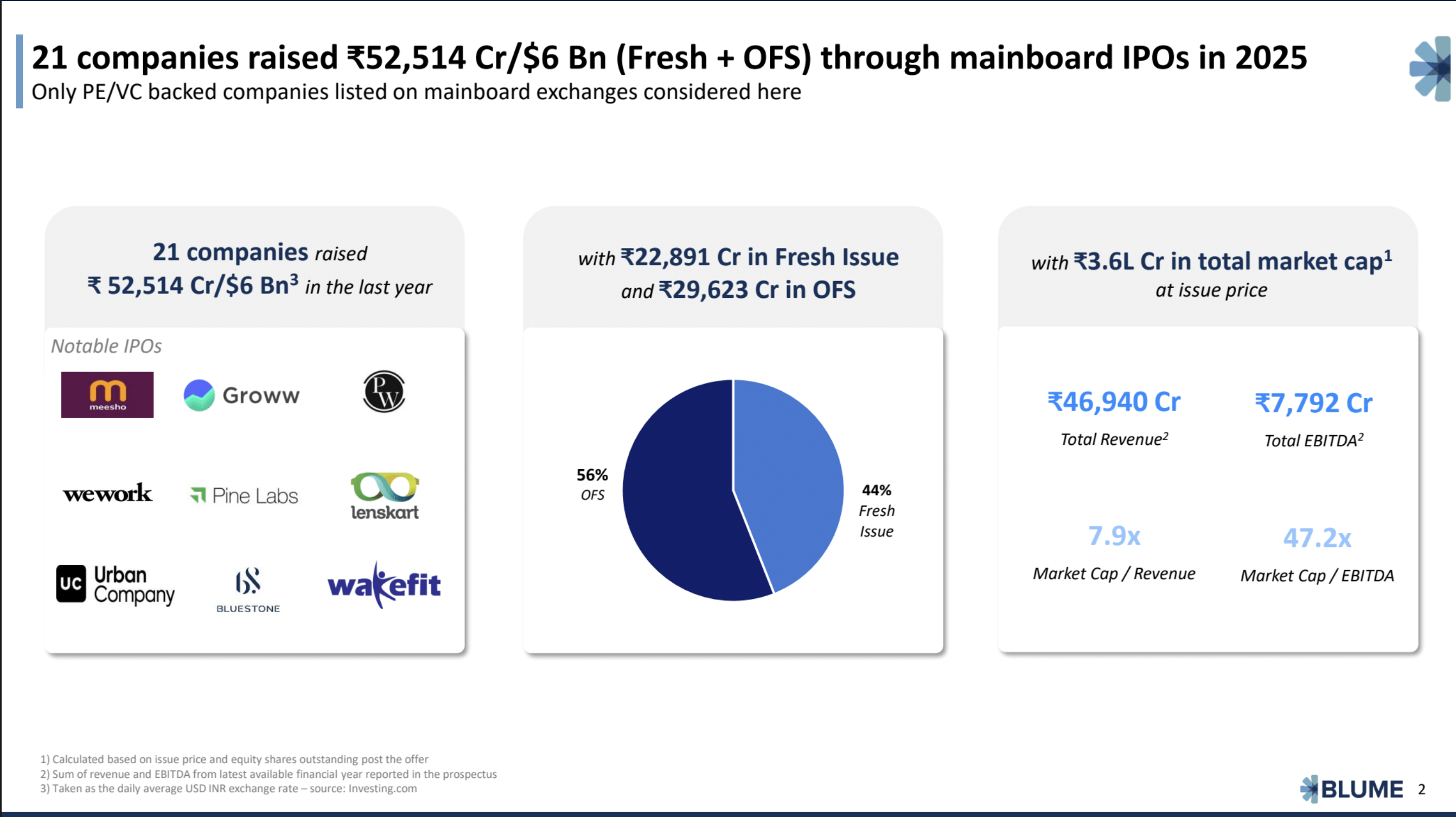
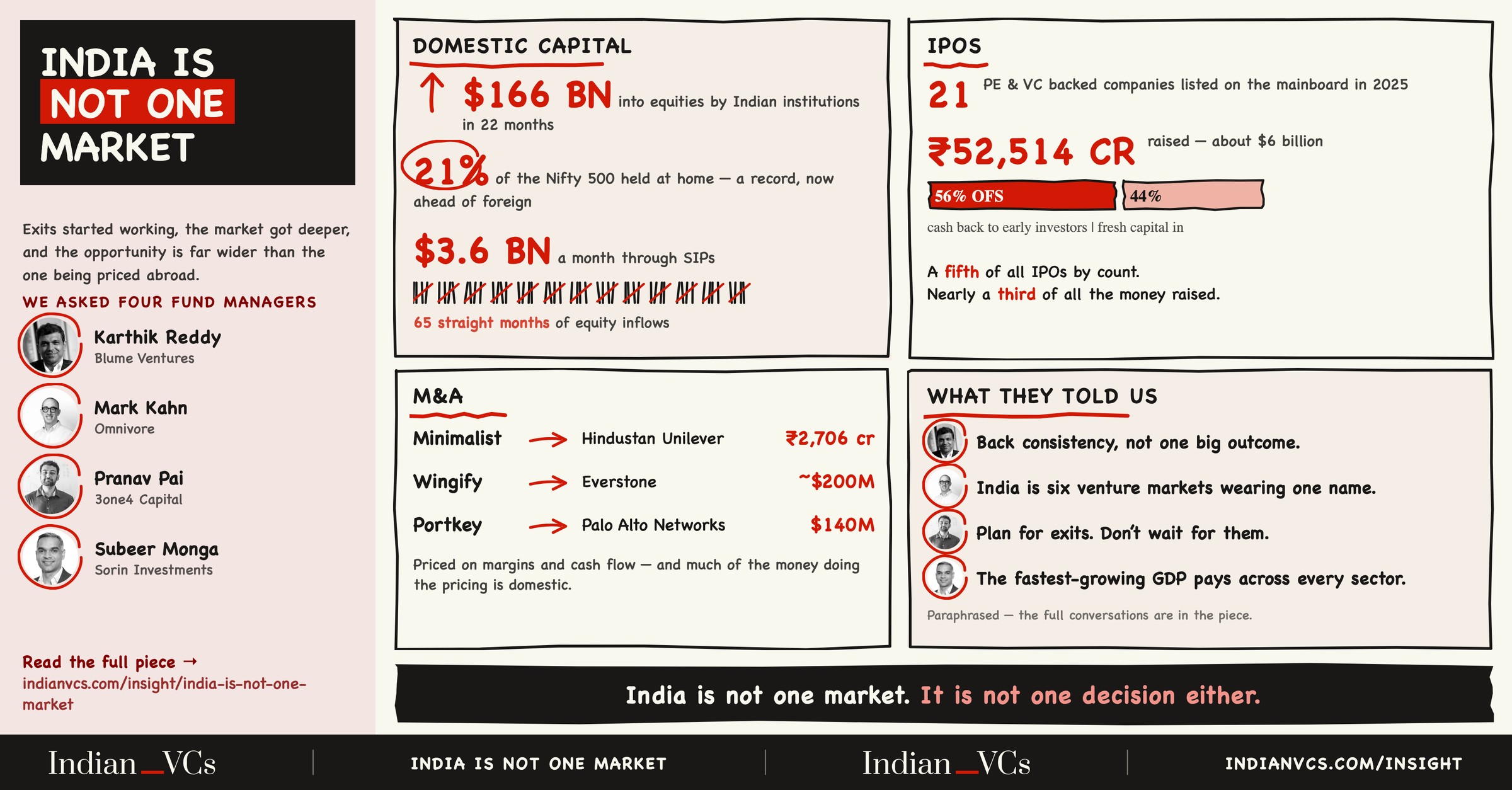
21 PE and VC backed companies listed on the mainboard last year. They raised around ₹52,514 crore, about $6 billion, and came to market at close to ₹3.6 lakh crore, roughly $41 billion, in combined value at issue prices. That's a fifth of all IPOs by count, and nearly a third of the money raised.
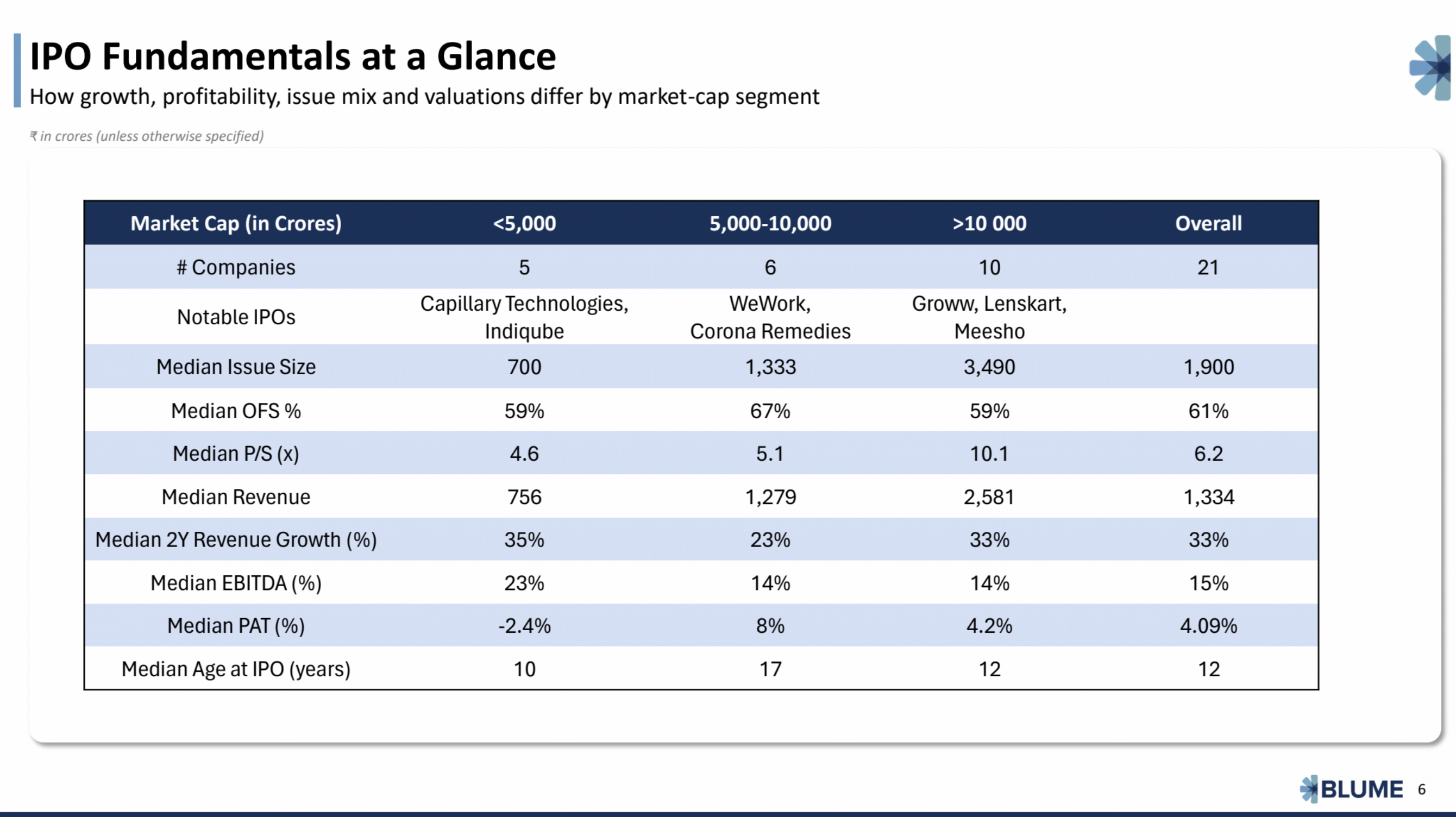
The useful detail is inside those issues. ₹29,623 crore of the ₹52,514 crore was offer for sale: money going back to early investors and shareholders rather than into the companies. That is what a working exit market looks like. And these were sound businesses listing. Across the cohort they did ₹46,940 crore of revenue and ₹7,792 crore of EBITDA, and the median company was twelve years old when it listed. The largest listings, those above ₹10,000 crore in market cap, priced at a median of 10.1 times sales against 6.2 times for the cohort.
The market got deeper
Underneath that sits something more important, and it is domestic money. For years this was a promise: domestic capital will come in and create the depth. It has stopped being a promise. Indian institutions have put $166 billion into equities over the past 22 months. Domestic ownership of Nifty 500 companies reached a record 21 percent in June and now sits comfortably ahead of foreign ownership. The bid for Indian companies is finally Indian.
The flow is steady rather than speculative. SIP contributions run at about $3.6 billion a month, and Indian equity funds have now seen 65 straight months of inflows.
The government is doing its part with capital more patient than venture money can be: ₹1 lakh crore (about $11 billion) through the RDI scheme for research and development, ₹10,000 crore through Startup India's Fund of Funds, ₹76,000 crore through the Semiconductor Mission, and defence programmes like iDEX that put government procurement behind young companies.
The exits are not only IPOs
A year ago the open question was exit predictability. There was really one path out, and it was narrow.
The listings did most of the work. Groww came to market in November, and Peak XV, which had put ₹232 crore in, has taken roughly ₹2,700 crore back in cash across the IPO and a block sale since, with most of its holding still unsold.
M&A opened up alongside. Hindustan Unilever paid ₹2,706 crore, a little over $300 million, for 90.5% of Minimalist in April 2025. Peak XV, which had seeded it in 2019, took a reported 10x, a cash return to investors. Everstone paid about $200 million for a majority stake in Wingify, a bootstrapped software company running at about $50 million of ARR. And Palo Alto Networks bought Portkey in May, three years after it was founded, for total consideration it disclosed at $140 million in its quarterly filing. Strategic buyers are paying real money for Indian businesses with real fundamentals. None of this erases the last cycle; entry prices from 2021 and 2022 took years to work through. What is different now is that companies are being priced on margins and cash flow, and much of the money pricing them is domestic.
When exits become predictable, funds stop waiting for them and start planning for them. Pranav Pai at 3one4 Capital puts it plainly.
We treat DPI as a design principle rather than something we hope arrives at the end of a fund's life. We have returned DPI within our committed tenures, and that record shapes the LP conversation more than any projection does.
Pranav Pai, 3one4 Capital
He also had one line on the size of the opportunity.
India will add more to its GDP over the next ten years than it did in its first seventy-nine years of independence, and that is a huge window to monetise.
Pranav Pai, 3one4 Capital
It is not only about the exits
The exits are the visible part. So we went back and asked people what they thought had actually changed underneath, and the answers were more interesting than the headline numbers.
Mark Kahn at Omnivore has been investing in India for over a decade, and his answer was about how the country gets read from outside.
India should not be approached as a single venture market. The opportunity looks very different depending on the stage, sector and time horizon. Consumer internet, fintech, enterprise software, agrifood, climate and deep tech all have very different capital requirements, exit dynamics and competitive landscapes.
Mark Kahn, Omnivore
The conditions underneath keep improving too. India has enormous datasets, millions of small businesses and farmers, complex supply chains, and a population that adopts digital products at scale, with India Stack cutting the cost of building and distributing on top of all of it. The consumer is changing as well. Mark points to a generation that increasingly cares what goes into what it buys and how it was made, which is quietly turning consumer health and planetary health into the same investment question.
We want to back companies that can use India as a laboratory and a scale market for deeptech, but build products that ultimately have relevance well beyond India.
Mark Kahn, Omnivore
Subeer Monga at Sorin makes a related point about how India gets framed abroad. The default is to benchmark the country against the US on technology, and lately only on AI.
The opportunities in India are vast including AI. We are a developing nation with the fastest growing GDP in the world. This allows us to participate across sectors via secular growth.
Subeer Monga, Sorin Investments
Subeer has been investing in India since 2010, twelve of those years at Mayfield, then ICICI Venture, then Sorin, and the companies he has backed make the point better than the argument does. Leap India, from his Mayfield years, rents pallets and containers, a category the US built out 50 or 60 years ago and which nobody had built at scale here. HomeRun is organising the fragmented home construction materials market. Neither is a technology story. Both are large.
Not one market with one thesis, but an economy large enough that several unrelated theses can all work at the same time.
What the people who have been here a decade say
None of the managers we spoke to are giddy about any of this, and that's the reassuring part.
They are planning. Building toward profitable companies, thinking about exits from the point of entry, and asking what they can deliver consistently across vintages rather than what a single outcome might do for one fund.
Karthik Reddy at Blume put it well when we asked him what an LP should actually look for here. Not one large outcome, but consistency: a team that has held together, results across several vintages and several sectors, and a credible case that the same thing can be done again over the next decade.
That's a harder thing to show than a single exit, and a more useful thing to look for. It is also something more Indian managers can now show, because more of them have now been at this long enough to have a record worth reading.
That is what two years has done. The line about unfulfilled greatness was written a quarter of a century ago, and for most of them it held. It reads differently now, and not because the potential finally showed up on its own. Everyone did their part: the companies got profitable, the domestic buyer showed up, the government wrote the patient cheques.
India is not one market. It is not one decision either.
- David Clark, CIO, VenCap, in conversation with Karthik Reddy at the Indian VCs Venture Summit, November 2024. Session: Decoding Power Law
- IPO cohort data, offer for sale split, revenue and EBITDA totals, median age at listing and valuation multiples: Blume Ventures, India's Exit Environment in 2025: A Structural Change, Not a Cyclical Spike
- Domestic and foreign ownership of Nifty 500 companies, June 2026 quarter: Motilal Oswal Financial Services, reported via ANI. DII inflows of $166 billion over 22 months: reported by Business Standard
- Monthly SIP contributions of ₹31,961 crore in July 2026: AMFI monthly data, reported by The Tribune. The unbroken run of positive equity inflows began in March 2021 and stood at 63 months as at May 2026, reported by Open; positive equity inflows of ₹28,973 crore in June and ₹24,697 crore in July 2026, reported by Outlook Money, extend the run to 65 months
- RDI Scheme corpus of ₹1 lakh crore, approved by the Union Cabinet on 1 July 2025: Press Information Bureau. Semiconductor Mission outlay of ₹76,000 crore, approved December 2021: Press Information Bureau
- Startup India Fund of Funds 2.0: Press Information Bureau
- Groww listing and Peak XV realisations: Groww RHP, reported by Entrackr
- Hindustan Unilever's acquisition of Minimalist: HUL exchange filing, April 2025, reported by Angel One. Peak XV's return multiple is as reported in trade press and has not been confirmed in a filing
- Everstone's acquisition of a majority stake in Wingify: TechCrunch
- Palo Alto Networks' acquisition of Portkey: company release, May 2026. Total consideration of $140 million in cash and replacement awards disclosed in Palo Alto's Q3 FY2026 quarterly filing